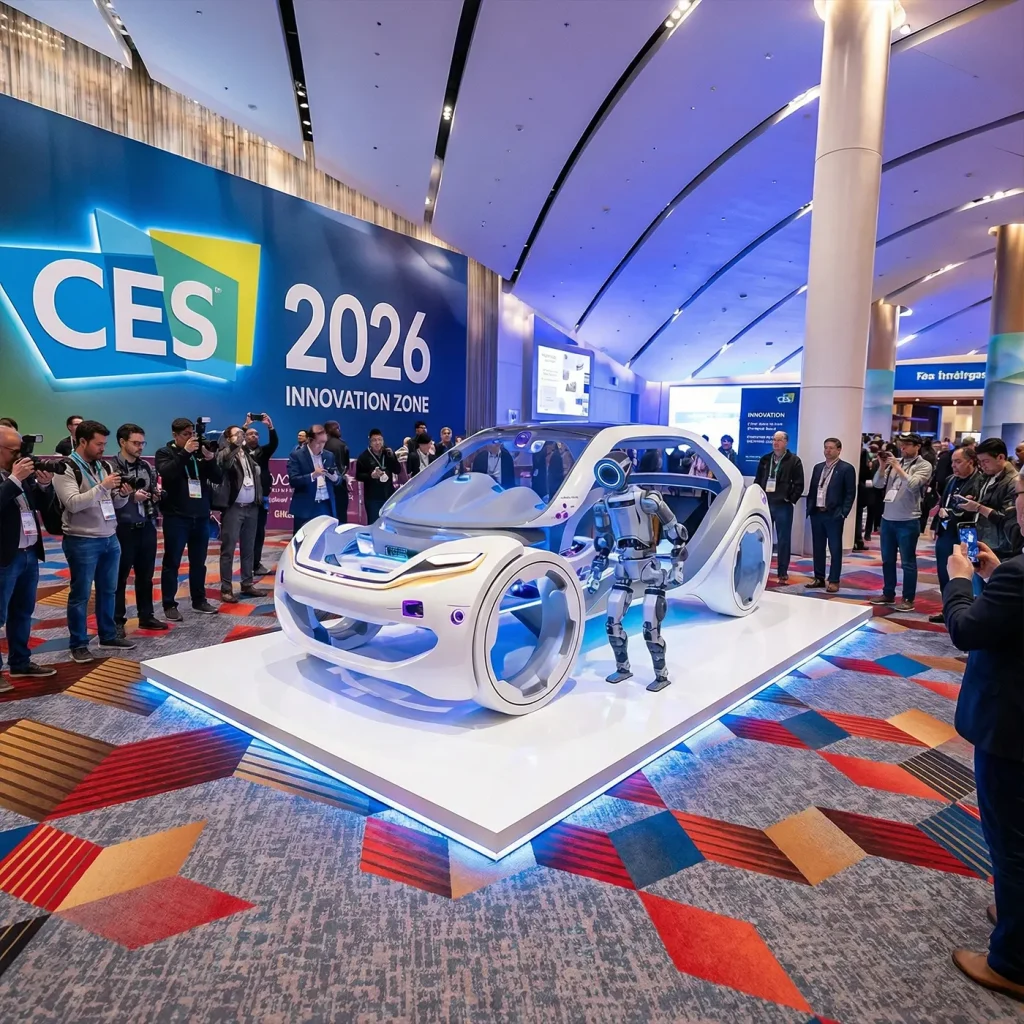
The story people told about generative AI in 2024 and 2025 was, in essence, a story about disembodied capability. Models lived in data centres, travelled over networks, and arrived as words, images, and synthetic voices. At CES 2026, that narrative changed direction. The show floor in Las Vegas became a catalogue of systems designed not only to predict the next token, but to perceive a room, interpret intent, and move with purpose. The practical emphasis was unmistakable. Robots were framed less as spectacle and more as labour, care, and logistics. Personal computers were treated less as sealed fashion objects and more as maintainable tools. Displays and vehicles were marketed less on raw novelty and more on the ability to adapt to messy real life, whether that meant glare, clutter, stairs, or uncertain road behaviour.
This shift matters beyond consumer electronics. The move toward physical AI raises questions regulators have not fully settled, such as product safety, auditability, repairability, and liability when systems act autonomously. It also changes what organisations must procure and govern. The crucial bottlenecks are no longer only data and compute in the cloud. They include sensors, actuators, battery chemistry, thermal engineering, and on device silicon capable of running models locally. If 2025 popularised the idea that AI could speak, CES 2026 made a stronger claim. AI can now arrive with hands, wheels, and consequences.
Fun fact: CES began in 1967, and it has repeatedly served as a preview of which technologies will become normal before they feel inevitable..
Robots With Reasoning Move From Demos Toward Deployment
One of the cleanest signals at CES 2026 was the industry’s decision to talk about robotics as an engineering programme rather than a magic trick. Humanoid machines were shown in contexts that looked less like a stage performance and more like a factory plan. The language shifted too. Instead of celebrating “autonomy” in the abstract, companies emphasised systems that can interpret context and justify actions, an idea sometimes bundled into vision language action models and other forms of reasoning models.
That framing is partly a response to reality. In controlled demos, scripted behaviour can masquerade as competence. In workplaces and homes, competence has to survive variation, error, and human unpredictability. The more robots are expected to do, the more they must be evaluated like safety critical products, with traceability of decisions and clear operating constraints. This is why explainability has become a commercial feature rather than a research aspiration. A machine that can articulate why it slowed down, rerouted, or refused a task is easier to certify, easier to trust, and easier to insure.
The same logic extends to consumer robotics, where the aspiration is not novelty but coverage. A stair climbing vacuum, for example, is not interesting because it looks futuristic. It is interesting because it reduces the household tasks that still require human intervention. In that sense, CES 2026 hinted at a broader truth about embodied intelligence. The breakthrough is not that machines can move. The breakthrough is that they can move usefully, in the spaces people actually live and work in, without constant babysitting.
Edge AI And On Device NPUs Become The New Default
The glamour of cloud delivered AI created a convenient illusion that latency, privacy, and connectivity were secondary. CES 2026 treated those constraints as the main event. As robots and context aware assistants move into private spaces, the cost of shipping data off device becomes harder to justify. It is not only a bandwidth problem. It is a governance problem, because sensitive audio, video, and biometric signals are difficult to protect once they leave the local environment.
The industry’s response has been to accelerate edge computing and build more capable NPUs into mainstream chips. The aim is not to eliminate the cloud. It is to change the division of labour. Always on perception, quick classification, and routine personalisation increasingly run locally, while heavier training and large scale inference can remain remote when needed. This architecture also supports reliability. A vacuum that cannot navigate because the Wi Fi drops is not a premium product. It is a liability.
There is a second order effect for policymakers and procurement teams. When intelligence moves onto devices, compliance and security shift too. Organisations have to evaluate not only service providers, but the hardware supply chain, firmware update policies, and the longevity of vendor support. The conversation stops being about which chatbot is cleverest. It becomes about who controls data flows, who can be audited, and who can be held accountable when a device behaves badly.
Repairable Design Turns Into Strategy Not Slogan
Sustainability was visible at CES 2026, but not primarily as recycled packaging theatre. The more meaningful shift was architectural. Manufacturers showed signs that maintainability and modularity are becoming competitive features, and in some markets, likely compliance requirements. The political pressure behind right to repair has grown because the costs of sealed devices are now widely understood. They raise household expenses, increase e waste, and lock users into vendor controlled service ecosystems.
A modular laptop design is not only a consumer friendly gesture. It is also a supply chain and risk management choice. If key components can be swapped without replacing the entire machine, organisations can extend fleet life, reduce downtime, and standardise spares. This matters for schools, hospitals, and public sector buyers who do not refresh hardware on fashion cycles. It also matters for businesses facing tighter sustainability reporting expectations.
CES 2026 suggested that “repairability” is moving from a niche enthusiast demand to a mainstream product proposition. The interesting question is whether brands will treat modularity as a premium tier perk or a baseline expectation. If it remains premium, inequality in durable access will widen. If it becomes standard, the market will start to measure laptops and appliances by service life and parts availability as much as by thinness.
Foldables And Rollables Try To Replace Two Devices With One
The personal computing storyline at CES 2026 was not only about faster chips. It was about form factors trying to earn their keep. A tri fold phone is, on its face, a display stunt. In practice, it is a bet that a single pocketable device can cover what many people currently split between a phone and a tablet. The pitch is productivity, not novelty, with claims focused on multitasking layouts, usable aspect ratios, and a better relationship between portability and screen area.
Rollable displays push a similar argument from a different angle. Instead of folding into a thicker object, they expand when needed and disappear when not. For mobile gaming and creative work, the benefit is not merely size. It is the ability to change aspect ratio, widening the field of view for games or giving more horizontal space for timelines, documents, and side by side panels.
These designs also expose the hard economics of durability. Moving parts fail. Flexible panels fatigue. Any credible push into rollables and multi hinge devices depends on materials science, hinge engineering, and long term testing that can survive scrutiny, not only marketing. CES 2026 indicated that manufacturers believe the failure rates are becoming manageable, but the market will only confirm that after years of daily use.
Micro RGB And OLED Reignite The Battle For Brightness
For much of the last decade, the display industry looked relatively linear, with incremental improvements around OLED and sophisticated LED backlighting. CES 2026 made it feel competitive again. Two futures were pitched side by side. One is OLED, pushed harder with new panel structures, glare reduction, and wireless external connection boxes designed to make screens feel like part of the room rather than a cable bound appliance. The other is Micro RGB, presented as a route to very high brightness and long life without the same concerns about organic material ageing.
What is striking is how brightness has become a proxy for broader priorities. Brightness now signals more than punchy highlights. It signals usability in bright rooms, resilience against reflections, and compatibility with living spaces that double as offices. At the same time, the push for brightness risks a return to wasteful escalation if it is not balanced with efficiency. CES 2026 showed vendors attempting to sell both, pairing brighter panels with language about smarter power management and more adaptive tone mapping.
Wireless input boxes added another layer. They promise cleaner installation and more flexible room design, but they also create new dependencies on proprietary ecosystems. If a wireless box fails and replacements are unavailable years later, the screen can become prematurely obsolete. This is where repairability and display innovation collide, and it is where regulators may eventually intervene.
Cars And Mobility Platforms Chase Explainable Autonomy
Vehicle technology at CES has often oscillated between realistic incrementalism and futuristic theatre. CES 2026 leaned toward a more sober proposition. Autonomy was framed as something that must be legible, auditable, and explainable, not only impressive in a demo. That aligns with the broader shift toward reasoning oriented stacks, where systems are expected to show their working in a way humans can understand.
This matters because driving is not a closed world problem. Rare events dominate risk. An autonomous stack that can identify objects but cannot anticipate intent will struggle in the edge cases that cause injury and litigation. The emphasis on systems that can interpret behaviour, such as a child’s attention shifting toward a rolling ball, reflects an attempt to encode the kinds of causal inference humans perform instinctively.
The mobility story also widened beyond passenger cars. CES 2026 featured devices aimed at independence and care, including mobility aids that use sensors and navigation to reduce cognitive load. The policy implication is that autonomy is not one market. It is a family of markets with different acceptable risks. A self navigating personal mobility device in a controlled environment is governed differently from a high speed car on public roads. Yet both raise questions about maintenance, updates, and who bears responsibility after a collision or malfunction.
Digital Health Moves From Tracking Toward Targeted Diagnostics
Health technology at CES has long been crowded with glossy wearables that promise insight without clinical clarity. CES 2026 showed more attempts to narrow the focus. Instead of measuring everything, some products tried to measure what matters for specific conditions and life stages, using sensors and software tuned to real needs. That shift is important because it moves health tech closer to accountability. A device designed for a particular problem can be evaluated against that problem, rather than judged on vague claims of optimisation.
The rise of products aimed at perimenopause management is illustrative. For years, women’s health has been underserved in mainstream consumer tech, despite substantial demand and clear public health relevance. A device that helps users log symptoms, correlate patterns, and bring structured evidence into clinical conversations can be valuable even if it is not a diagnostic medical device. The risk, of course, is overclaiming. The boundary between “support” and “medical promise” is where consumer tech often gets into trouble.
Parent and infant tech offered a similar lesson. Tools that reduce anxiety by providing clearer information can be helpful, but they also risk creating new forms of stress when data becomes a constant judgement. The most responsible products will be those that treat measurement as a means to better decisions, not a mandate to monitor everything all the time. In a world of ambient intelligence, health data is among the most sensitive signals a device can collect. The governance of that data will define whether the category earns long term trust.
Sexual Wellness And Weird Tech Reveal The Politics Of Intimacy And Surveillance
The fringe of CES has always been an early warning system. CES 2026 made that function explicit. AI companions, intimacy devices, and emotion tracking gadgets drew attention not only because they are provocative, but because they turn private experience into product design. “Sexual wellness” branding reflects an effort to treat intimacy technology as part of health and wellbeing, not a sideshow. That reframing brings benefits, including more open discussion of loneliness, disability, and long distance relationships. It also brings sharper ethical scrutiny.
AI integrated companion products raise questions that sit at the intersection of psychology and consumer protection. If a device can maintain conversation, remember preferences, and simulate attachment, it becomes something more than a tool. It becomes a relationship proxy. The potential upside is companionship for people who are isolated. The potential downside is dependency, manipulation through monetisation, and the collection of highly sensitive data about behaviour and desire. For policymakers, these devices pose a familiar but intensified challenge. Consent, privacy, and advertising rules were not designed for products that live in bedrooms and listen for emotional cues.
Meanwhile, the “weird tech” category at CES 2026 also highlighted a different anxiety. Many gadgets now depend on continuous sensing, facial recognition, and behavioural inference to feel “helpful”. Consumer advocates have begun to treat that trend as a privacy risk disguised as convenience. The point is not to mock odd inventions. It is to notice what they normalise. A device that tracks your face to maintain eye contact is a technical feat. It is also a signal that surveillance features are being packaged as companionship, which may soften resistance to broader monitoring in homes and workplaces.
What The Shift From 2025 To 2026 Means For Research And Policy
A year on year comparison of CES themes is useful because it separates hype cycles from durable direction. CES 2025 was strongly shaped by cloud delivered assistants, generative features, and the promise that software updates could transform existing hardware. CES 2026 did not abandon that. It repositioned it. Intelligence was increasingly treated as something that must be embodied, locally responsive, and integrated into devices that can act.
For researchers, this pushes attention toward evaluation in the real world. Benchmarks that reward language fluency are not enough for systems that move through houses, factories, and roads. New metrics are required, measuring reliability, safety, energy use, and recoverability after failure. For policymakers, the agenda expands. It includes product safety standards for autonomous behaviour, repairability requirements that keep devices serviceable, and data protection rules that can handle always on sensors embedded in domestic life.
For the market, the clearest lesson is that utility has returned as a status symbol. The most persuasive products at CES 2026 were not the ones with the loudest claims. They were the ones that solved stubborn practical problems, such as cluttered workflows, cable management, glare, or the physical limits of robots confined to flat floors. The industry is still chasing spectacle, but it is also learning that spectacle alone is no longer enough.
Conclusion
CES 2026 did not merely introduce new gadgets. It clarified a transition. Physical AI is becoming the connective tissue between consumer electronics, industrial systems, and public policy. That development carries promise, from safer assistance devices to more capable household automation. It also carries risk, from fragile proprietary ecosystems to invasive sensing sold as comfort.
The most significant change is that AI is no longer confined to what it can generate on a screen. It is being asked to perceive, decide, and act in the material world, where mistakes cost money, safety, and trust. The next phase will be shaped less by who can produce the cleverest demo, and more by who can produce systems that can be audited, repaired, and governed at scale. In that sense, CES 2026 felt like watching a new kind of infrastructure take shape. It was less like reading a brilliant essay and more like seeing a bridge under construction, where every bolt matters because people will eventually have to cross it.